Open the garage of a typical American house and you’ll usually see the same thing. The car is parked outside. The mower takes the best corner. Rakes and shovels line the walls. Christmas decorations fill the shelves. The bikes nobody rides anymore block everything else.
At some point, most homeowners hit the same wall: we need a shed.
From this simple idea, then comes the harder and real question: what size? Shed manufacturers and installers hear this constantly. And the answer surprises people. Bigger isn’t automatically better. A shed that’s too small becomes a headache fast. You have to move three things just to reach the one you want. But a shed that’s too large has its own problems. It costs more, requires a bigger foundation, eats up yard space, and depending on where you live, it might require a permit or run into setback rules. The right shed needs to fit your life today with a little room for tomorrow. Start with the right question. Most people measure their lawn mower, check the shed dimensions, and figure they’re done.
But the first question isn’t “what can I fit?” It’s “what do I want to be able to do easily once it’s in?”
That difference matters more than it sounds. A push mower is about 22 to 24 inches (0.61 m) wide. On paper, a small shed looks fine. In practice, you also need to open the door without hitting the mower, turn the machine around, and grab tools from the back without unloading everything first.
A shed isn’t just a place where things go. It’s a place where you move around and actually work. Experienced installers think in terms of usable space, not just square footage. Two sheds with identical outer dimensions can feel completely different depending on door width, wall height, shelf placement, whether there’s a loft, and how the interior is laid out.
Why the 10×12 keeps coming up?
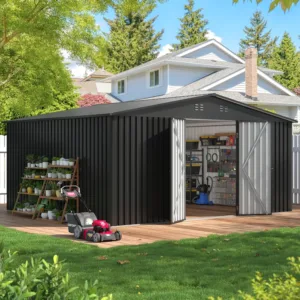
Visit any showroom from manufacturers like Tuff Shed or Sheds Unlimited and one size comes up again and again: the 10×12. There’s a reason for that. At 120 square feet, a 10×12 handles the needs of most American families. A lawn mower, garden tools, a few bikes, storage bins, seasonal decorations, some shelving, sometimes a small workbench. It’s large enough to breathe but compact enough to fit most yards without taking over.
Think of a family in suburban Ohio or North Carolina. The garage isn’t a workshop. It just holds everything: garden equipment in summer, Christmas stuffs in winter, patio cushions, kids’ bikes, a few tools. That family probably doesn’t need a 12×20. But an 8×10 might fill up faster than expected. The 10×12 tends to be the sweet spot.
Storage takes up more space than you think. An empty shed always looks bigger than it is. Installers know this well. The building arrives and feels almost huge. Then the shelves go in, then the bins, the wall hooks, the mower, a few tools. A few months later, moving around inside feels very different.
A standard shelf runs about 12 inches (ca. 30 cm) deep for smaller items, 16 to 18 inches (45.72 centimeters) for heavier bins, and 24 inches (0.61 meters) or more for a workbench. In a small shed, those numbers add up fast. Shelves on both sides can turn an open space into a narrow corridor.
This is why experienced installers often ask: what needs to stay on the floor, and what can go on the walls? A rake, shovel, or ladder can hang. A self-propelled mower can’t. That question often matters more than adding a few extra square feet.
Don’t overlook height when comparing sheds, most people look at length and width. Height usually comes last. That’s a mistake. Taller walls let you hang tools, add vertical shelving, install a loft, and keep the floor clear for large equipment. In many cases, using vertical space is smarter than expanding the footprint. A shed can feel significantly more functional without getting any bigger on the ground. Access matters as much as square footage. Here’s something many people only figure out after installation: getting things in and out can matter more than having a few extra square feet.
A common situation. Someone buys a riding mower. They measure it, confirm it fits, and order the shed. A few weeks later, they realize they have to turn the steering wheel at a precise angle, avoid the shelf on the left, move a bin before pulling out, and maneuver in a space that’s just a little too tight. The shed isn’t too small. The access is.
Before recommending a size, experienced installers often ask one question: what’s the largest thing you’ll probably put in this building? Not just what you have now, but what you might buy in five years. A push mower today could be joined by a snow blower, a tiller, an electric bike, or a full set of power tools. A wider door gives you flexibility that’s nearly impossible to add later.
Gambrel roofs are more than just a look. This is one of the most recognizable shapes in American shed design. Its barn-like silhouette feels traditional and familiar. But the real advantage isn’t the look. It’s the extra interior volume. A standard gable roof creates a triangular space under the peak. That space gets harder to use near the walls as the ceiling drops. A gambrel roof changes the geometry. The walls stay taller longer, which makes adding a loft practical.
The lower level handles the heavy stuff: mower, tools, bikes, a workbench. The loft takes the lighter seasonal items: holiday decorations, camping gear, patio cushions. The footprint stays the same, but the building becomes much more useful. One thing worth knowing: a loft needs to be built for the load it will carry. Light items like decorations and empty boxes aren’t a problem. But bags of material, books, or mechanical equipment add up quickly. The structure has to match the intended use.
The foundation: easy to overlook, hard to fix
When a new shed arrives, everyone looks at the siding, the windows, the doors, the roof. The foundation is almost invisible. But it directly affects how long the building lasts and how well it functions. A shed on a poor base can develop doors that won’t close, corners that go out of level, and persistent moisture problems. A more expensive building won’t fix a bad foundation. A well-built shed on a properly prepared base will almost always outperform a higher-end model sitting on poorly prepared ground. Compacted gravel works well for most residential sheds. It drains well, costs less, and is easier to install. But it has to be done right. A few inches of gravel dumped on grass isn’t a foundation. Proper prep means removing the topsoil, leveling the ground, adding crushed stone, and compacting it mechanically. A base that moves will eventually move the building with it.
A concrete slab makes more sense when the shed is doing heavier work: a workshop, storage for large equipment, or year-round use. Concrete gives you a rigid, clean, stable surface. It also requires more planning. Drainage, thickness, reinforcement, local climate, and frost depth all matter. A poorly designed slab can trap water instead of draining it.
Moisture is the main threat to a wood shed
Wood has been used in American buildings for generations. It’s not a bad material. The real problem is prolonged moisture. Wood doesn’t fail because it got wet once. It fails when the same moisture problem repeats for years. Keeping a shed dry means preventing direct contact with the ground, directing rainwater away from the base, maintaining ventilation, and avoiding low spots in the yard where water pools. Get those things right and a wood shed will last a long time.
Three common situations
The homeowner who wants to clear out the garage. A push mower, some garden tools, seasonal decorations, a few boxes. An 8×10 can work well here. With wall hooks and smart organization, it stays usable for years.
The average American family. Two cars, a yard, kids. Bikes, a mower, garden gear, patio furniture, seasonal storage. The 10×12 is usually the most balanced choice. Big enough to grow into without taking over the yard.
The homeowner who wants a real workspace. A riding mower, snow blower, power tools, a workbench, ongoing projects. A 12×16 starts to make a lot of sense. It stops being just storage and becomes a small workshop.
The question worth asking before you buy. Don’t just ask what size fits in your yard. Ask how you want to use the space ten years from now. A good shed grows with your home. Today it stores the mower. Later it might become a workshop, a hobby room, better organized seasonal storage, or a small home office. The best decision isn’t always the biggest building. It’s the one that actually fits your life.